M&M Cookies

thumbnail_20180203_130745It’s hard not to love M&M cookies — easy, fun, and just plain yummy.

Years ago in a magazine was a recipe for “cookies by the stack” — a single cookie dough recipe that could be used with any number of mix-ins, from coconut flakes and chopped nuts to dried fruit or chocolate pieces. I glued the entire magazine page into my cookbook because it was so useful. I’ve made some of the variations on the page, but I use the recipe most often for chocolate chip cookies (see below).

These are going to taste good no matter what. It’s hard to mess them up! But if you want them to look good, too, there’s a trick: Mix only half of the M&Ms into the dough, and put the rest on by hand before they go in the oven. If you don’t, they won’t show up very well, as you can see here:

thumbnail_20180203_131141

The cookies on the right had all the M&Ms mixed into the dough. The cookies on the left had only half mixed in, with the rest put on by hand.

The food scientist and cookbook author Shirley Corriher, in her terrific book “Cookwise: The Secrets of Cooking Revealed,” explains how shortening and butter can affect the spread of the dough and give you either a flat, crisp cookie or one that holds its shape. Butter melts over a narrow temperature range, so if you use all butter in the recipe, the cookies will spread soon after they go in the oven.

Shortening, on the other hand, stays the same texture over a wide temperature range, she says — so cookies made with part butter and part shortening will hold their shape better than if you use all butter. This recipe uses both in an equivalent ratio. Knowing the difference in fats, you can tweak the recipe how you like — if you want a crisper cookie, use more butter, for instance.

I mentioned chocolate chip cookies earlier. If you’d rather make those, just replace the 2 cups of M&Ms in this recipe with 2 cups of chocolate morsels (semi-sweet). Three other variations are below.

1/2 cup shortening
1/2 cup unsalted butter, softened
1 cup packed brown sugar
1/2 cup granulated sugar
1/2 tsp. baking soda
2 eggs
1 tsp. vanilla
2 1/2 cups all-purpose (plain) flour

Set oven to 375F (190C) degrees.

In a large mixing bowl, beat the shortening and butter with an electric mixer on medium to high speed for 30 seconds. Add the two sugars and baking soda and beat until fluffy.

Add eggs and vanilla and beat until combined. Stir in flour by hand, then add half the M&Ms.

Drop dough by slightly rounded tablespoons 2 inches apart on an ungreased cookie sheet, then place reserved M&Ms on top (crowd them together for best results). Bake 10-12 minutes or until the edges are light brown. Let cool on a wire rack.

*The dough can be kept for up to 24 hours in the refrigerator, or frozen for up to 6 months (thaw overnight before baking).

Variations:

PEANUT BUTTER-CHOCOLATE CHIP COOKIES
Replace the M&Ms with 1 cup peanut butter morsels and 1 cup semi-sweet chocolate morsels. Mix it all in the dough.

COCONUT-WALNUT COOKIES
Replace the M&Ms with 1 cup coconut flakes and 1 cup chopped walnuts.

FRUIT AND OATMEAL COOKIES
Substitute 1 cup rolled oats for 1 cup of the flour. Stir in 1 tsp. ground cinnamon into the flour mixture. Stir 6 oz. of dried fruit bits into the dough.

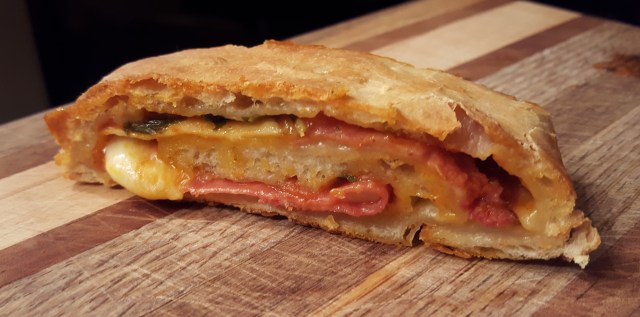
Stromboli

Stromboli2
A baked sandwich roll of pizza dough, marinara sauce, meat, and cheese, stromboli is an easy dinner idea that will make your kitchen smell delicious. Working with the pizza dough takes a bit of practice, but it’s easy once you get the hang of it. You can vary the meats and cheeses however you like. And if you’re feeding a crowd, just make two of these at the same time.

I learned the hard way that being a baker doesn’t necessarily mean you know pizza dough. The gluten makes it stubborn and stretching the dough requires patience. (You can’t be stubborn if the dough is, too.) The first night I tried to make this, I failed — I was so determined to get the dough into the shape I wanted that I pushed and pulled and ended up ripping the dough, which never got much bigger than the size I started with anyway.

The key, as I then learned, is to take the dough out of the fridge two hours before you need it and to take your time stretching it. Be gentle. Lay it down between stretches and return to it five minutes later. In a while, it will get to the size and shape you want.

Inspiration for this recipe came from Guy Fieri and Bon Appetit magazine. Amounts for the meat and cheese are approximate.

Serves 4

1 lb. refrigerated prepared pizza dough
Olive oil
3/4 cup marinara sauce, plus extra for dipping
2 cloves garlic, minced
Grated Parmesan
2 large spoonfuls basil pesto
3 oz. thinly sliced salami
3 oz. other thinly sliced deli meat, like ham or turkey
8 thin slices mozzarella
8 thin slices provolone

Remove pizza dough from refrigerator 2 hours before using.

The goal is to get the dough into a large rectangle, roughly 9 x 12 inches, or even slightly larger. With floured hands, start by flattening the ball of dough, then picking it up and holding it from the edges, moving your fingers around the circle, pausing for a few seconds each time to let gravity gently pull down the dough.

Set it down and wait 5 minutes before starting the stretching process again. You will need to do the stop-and-wait about 3 or 4 times before you achieve the right size. Be patient! At some point during the stretching process, turn the oven to 375F degrees.

As your dough stretches, keep in mind that you want it to become a rectangle. Stretch the dough as best you can into the rectangle shape.

When the dough is the right size, lay it on top of a large piece of parchment. (Work swiftly so the dough doesn’t decide to shrink again.) With one of the long edges closest to you, brush the dough with a little olive oil, then spread with marinara, leaving a 1-inch border all around. Top with minced garlic, Parmesan, and a ribbon of pesto going from one side to the other.

Cover the sauce with slices of meat (I had room for four rows lengthwise, 2 rows for salami and 2 for ham). Cover the meat with the cheese slices in the same way.

Starting with the end closest to you, roll it into a log, using the parchment paper to help you roll if needed. Gently pinch the sides together as you go. When you reach the end, gently press down on the seam and turn the log seam-side down on the parchment. Lift the parchment with the log on top onto a baking pan, then bake 25-30 minutes.

Let cool about 5 minutes, then use a serrated knife to cut into slices. Serve with some marinara sauce on the side for dipping.

stromboli3.jpgStromboli1

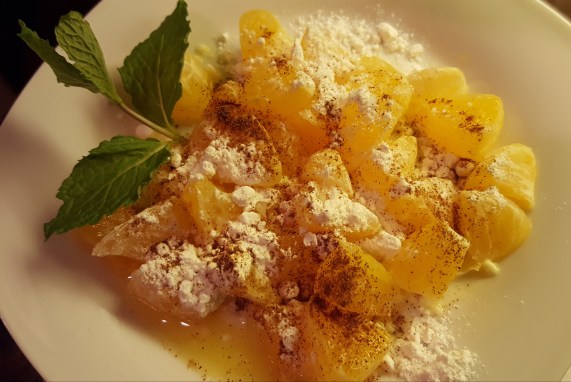
Moroccan Orange Salad with Cinnamon

20180107_174402

This recipe is originally from Mourad Mazouz, the owner of the London restaurant Momo. It’s a wonderful, easy, and elegant way to serve oranges as part of a meal. Bonus: It can be plated up and made ahead.

We had a “breakfast for dinner” night and this was on the table with homemade pancakes and breakfast sausage. Everyone finished their plate, including my children, who devoured it. My son even enjoyed the garnish of fresh mint!

I have changed the recipe a little from the original, which I got at some point while we were in London. His calls for regular oranges that are seedless, which I couldn’t find at this time of year, so I used mandarins. His recipe said to slice the peeled oranges, which is difficult with mandarins, so I broke them up into sections and cut the sections into small pieces. That was more accessible for my children anyway.

Serves 4

5 mandarin oranges, peeled with pith removed
2 Tbsp. powdered (icing) sugar
2 Tbsp. orange juice (best if freshly squeezed)
1 tsp. ground cinnamon
4 sprigs of mint leaves

Separate mandarins into sections, then cut each section into four pieces and divide them evenly onto plates. Sprinkle with sugar (depending on your preference, you may not want to use it all), then orange juice, then cinnamon. Put a sprig of mint on each plate. Serve chilled.

Thai Chicken Peanut Satay

This recipe came about because I found some Thai peanut satay sauce on sale at the store. I knew I wanted to serve it with chicken skewers, but I needed some ideas. Improvising with chicken is not something I’m good at.

There are many versions online. Lots of them were for grilled skewers, but I wanted to use the oven. Some used the peanut sauce for basting, but I wanted to use it for dipping. After a lot of searching, I found two chicken skewer recipes from the Food Network (their recipes always work for me!) that I combined to make a perfect easy dinner. One recipe gave me the idea to marinate and the other had the cooking instructions.

Here’s the result. I served this with sesame broccolini (trim stems on the diagonal, parboil, drain, drizzle with sesame oil, sprinkle with sesame seeds, serve hot.)

Serves 4

1 7-oz. jar Thai peanut satay sauce
2 1/2 lbs. skinless, boneless chicken breasts
Large handful of cilantro (fresh coriander)
12-14 long bamboo skewers

For the marinade:
1 Tbsp. hoisin sauce (I know it’s not Thai, but it worked)
1/2 cup lime juice
4 Tbsp. agave
2 Tbsp. soy sauce
2 Tbsp. minced fresh ginger
4 garlic cloves, minced

Whisk the marinade ingredients together and set aside.

Trim the chicken, then cut into strips. Length doesn’t matter too much, as long as they’re not more than 5 inches or so. You can always put two small strips together on a skewer. Don’t make them too wide — maybe between 1 and 1 1/2 inches.

Whisk the marinade again briefly, then pour into a large bowl. Add the chicken and let marinate 1-2 hours in the refrigerator.

Soak the bamboo skewers in water for 1 hour so they don’t burn in the oven. A good idea is to lay them in a rimmed baking pan (which you’ll use for the skewers later) and pour enough water on top to cover them.

Preheat the oven to 375F/190C degrees. Remove the bamboo skewers from the pan, empty the water, and line the pan with a sheet of foil.

Thread the chicken strips onto the skewers, leaving space on one end for handling, as with a popsicle stick. Place them on the foil and bake for about 30 minutes, or until cooked through.

While they’re cooking, pinch off four cilantro sprigs, chop the rest, and set aside. Pour the satay sauce into small individual serving bowls and stick a cilantro sprig in each. Make the broccolini, if using.

To serve, stack all the skewers on a large plate and sprinkle the cilantro on top. Put the broccolini in a serving bowl. Place both on the table for everyone to help themselves.

Cookie Frosting

20170703_165159

Adapt the decoration on your cookies, or the color of the frosting, for any holiday.

This creamy frosting is a fun, easy way to decorate cookies. It’s not as fancy or sophisticated as icing, which is smooth and glossier, but it’s simple and yummy, and decorations like sprinkles stick to it easily. It’s especially perfect for spreading on sugar cookies.

I got this recipe years ago from a Williams-Sonoma booklet on making Christmas cookies. I keep that booklet in the front pocket of my dessert recipe binder and refer to it often when making any kind of cookie that needs decorating.

This makes about 3/4 cup, or enough to frost 2 dozen regular cookies (about 2 1/2 inches in diameter).

With the brown vanilla extract, the frosting comes out an off-white color. Try a clear extract if you want it pure white, maybe playing around with some flavors of extract to see how it turns out. This can also easily be tinted with food coloring.

2 cups confectioner’s sugar (powdered or icing sugar)
2 Tbsp. unsalted butter, melted
1 tsp. vanilla extract
2 Tbsp. heavy cream
Food coloring, if desired

Sift the confectioner’s sugar into a large bowl about 1/2 cup at a time. Add the melted butter, vanilla, and cream. Using an electric hand mixer, beat on medium speed until creamy and spreadable.

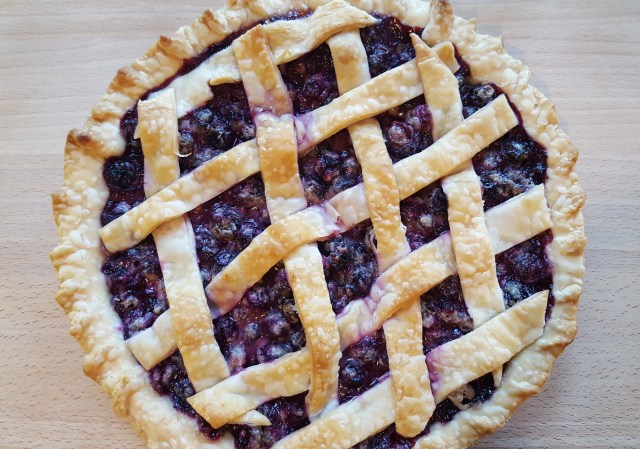
Blueberry Pie

20170607_190952A

(Note: I have updated this recipe to include Clear Jel, a thickener that solves the problem of runny fruit pies.)

Whether you’re great at making pies or not, there ought to be at least a few pie recipes in your book that you’re able to make with some confidence. I am no pro at pies and stick mainly to the non-fruit kind, since they’re not so messy — key lime, chocolate pecan, and buttermilk coconut pie are my favorites.

But fruit pies are pretty easy, too, and they’re classic. I make Rose Levy Beranbaum’s apple pie and this blueberry pie. The filling spills all over the place when I serve them, and I’m still working on that (suggestions are welcome), but I seem to be the only one who minds. Everyone always just digs right in.

It used to be so frustrating to spend time making a pie only to have the slices fall apart when I cut them. Was I missing some baking secret or special trick? A couple of online searches for “fix runny fruit pies” yielded a magic ingredient: Clear Jel. It’s a modified cornstarch that is added to the filling before baking and holds the filling together when slices are cut.

Clear Jel is available in big bags online. The smallest bag I found was one pound, and since only a few tablespoons are needed for each pie, I expect it to last a while. If you buy some, look for the instant kind.

Makes one 9-inch pie

3/4 cup granulated sugar
1/4 cup firmly packed brown sugar
1/2 cup all-purpose (plain) flour
3 Tbsp. instant Clear Jel
1/2 tsp. ground cinnamon
1/4 tsp. ground allspice
5 cups fresh blueberries
1 Tbsp. lemon juice
1 Tbsp. butter, melted
2 refrigerated pie crusts
1 tsp. granulated sugar for topping

Preheat oven to 400F (200C) degrees.

In a large bowl, combine the first nine ingredients, tossing gently with a rubber spatula. Fit one pie crust in a 9-inch pie plate according to package directions, carefully cutting off the overhanging crust. (Save the scraps.) Spoon blueberry mixture into pastry shell.

Use the scraps for the lattice on top of the pie. Gather them into a ball, then roll it out to 1/8-inch thickness. Cut into strips and arrange in a lattice design on top of the pie. If you need more strips, use the other pie crust. I cut my strips to fit inside the pie shell; if you have enough dough, you can lay the ends over the edges of the pie shell and press them in. Then crimp or pinch the edge of the pie in whatever design you like.

Sprinkle the teaspoon of sugar on top of the pie, then place in the oven. Bake 40-45 minutes until golden, shielding the edges with strips of aluminum foil halfway through to prevent excess browning.

(Credit for this recipe goes to a lady named Nan Ferguson of Sandy Springs, Georgia, who submitted it to The Atlanta Journal-Constitution about 20 years ago.)

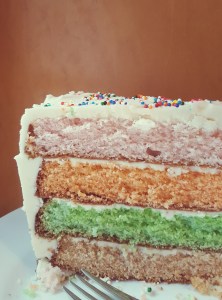
Rainbow Birthday Cake

rainbow birthday cakeHere’s a way to dress up a white cake for special occasions. The layers are colored and the frosting is white, so when slices are cut it’s the inside that stands out.

I was inspired by a picture I clipped from a magazine ages ago that showed four layers in graduating shades of blue. There was no recipe, if I recall — just the picture. But it was easy to copy using my existing recipes for white cake and buttercream frosting.

My son requested this cake for his birthday with four layers, each in one of our favorite colors. That was orange, green, red, and pink. I can foresee making this on holidays — shades of red and pink for Valentine’s Day, pastel colors for Easter, or red, white, and blue (maybe with another layer of white containing sprinkles?) for Independence Day.

The white cake recipe above yields two 9-inch round layers. I made the recipe twice to get four layers. Each time I made the recipe, I divided the batter evenly into two large measuring cups and tinted them with gel colors before pouring into the baking pans.

I also doubled the buttercream frosting recipe above.

Now, you’ll see from the picture that the cake is missing the red layer my son requested and has a brown one instead. That one counts as a lesson learned. I decided to use some red beet powder as a natural red food coloring — I had used it before to tint frosting — but this time, the cake turned out the color of whole wheat bread. I looked it up and it seems that the baking process, and maybe a reaction to the baking powder, turned the red beet powder brown. Oh, well. I know for next time.

A note on the frosting: For this cake, you want the colored layers to stand out, so you shouldn’t put a lot of frosting between them. Put just a small amount to act as a glue to hold the layers in place. The thin ribbon of white you’ll see between each layer when you cut the cake is also just enough to show off the colors.

Hard-boiled Eggs

There isn’t much to say about this recipe, but it’s a basic one that ought to be in your cookbook somewhere. I’ve been making more of these lately so we can dye them for Easter eggs.

1. Wash eggs to be hard-cooked in warm soap and water.

2. Place eggs in a single layer in an enamel, glass, or steel pan.

3. Add enough tap water to come at least 1 inch above the eggs.

4. Cover the pan and rapidly bring the water to a boil. Then turn off the heat. If you’re using an electric range, take the pan off the burner.

5. Leave the cover on the pan. Let large eggs sit for 15-17 minutes; medium eggs about 3 minutes less; extra-large about 3 minutes more.

20170405_115302

6. Heat retained in the water will continue to cook them, so remove eggs with a slotted spoon and transfer to a bowl of ice water. Cooling helps prevent the green rings that sometimes form around the yolks.

20170405_115402

Notes:
Don’t worry if the eggs crack a little during boiling, because they are still cooked and perfectly edible. If you dye them, part of the egg underneath the shell will be colored, but since most egg dyes are food-safe it won’t matter.

To eat them, tap the eggs gently on a hard surface to make cracks, then gently peel off the shell.

Slice or cut them into chunks, sprinkled with a little salt. Chop them for an egg salad sandwich or crumble them for a salad. Or make them into deviled eggs — see my recipe here.

Candied Pecan Popcorn

20170128_162714This is a recipe that could earn you a lot of friends. I brought a container of this to work, and it was soon gobbled up by colleagues who asked me not to bring it in again because they didn’t need the temptation.

The original recipe came from the Food Network magazine, which always seems to have recipes that just simply work. It was the creation of Marcela Valladolid, who called for the addition of chipotle seasoning, but I leave that out in my version. Here is the recipe, with a few more changes from the original.

11 cups popped plain popcorn (very important: inspect carefully and remove all unpopped kernels)
1 cup pecans, roughly chopped
1 cup packed dark brown sugar
4 Tbsp. unsalted butter
1/4 cup honey
1 tsp. salt
1/4 tsp. baking soda

Heat oven to 250F degrees. Line a rimmed baking sheet with foil and butter the foil.

When oven is hot, put popcorn on the pan and scatter the pecans on top. Place in the oven while you do the next step.

Place the sugar, butter, and honey in a small saucepan and heat over medium-low, stirring occasionally. When the sugar and butter have melted, increase the heat and boil for 4 minutes, stirring constantly. Remove from heat and quickly stir in salt and baking soda.

Remove popcorn from oven and pour the syrup on top, then mix gently with a rubber spatula to coat as much of the popcorn as possible. Bake for 1 hour, stirring with the spatula halfway through to coat more popcorn.

Remove from oven, stir once more, and let cool. To remove cooled popcorn from foil, lift it up at each end, gently moving the foil around to ease the popcorn off.

White Bean Soup

20161203_134150This easy soup looks and tastes like it could be served in a restaurant. I love the creamy base, which you get not from cream, but from pureeing some of the beans. It’s a trick I didn’t know before, and I love it because it keeps the calories and fat content low.

The recipe came from Dallas chef David Holben and was served at his former restaurant, Mediterraneo. I clipped it years ago from the Atlanta Journal-Constitution. The original recipe called for cooking bacon, then using the bacon fat to cook the onions. I omitted the bacon and replaced the fat with olive oil.

Makes 4 servings

Olive oil
1/2 large yellow onion, finely chopped
2 15-oz. cans white (Great Northern) beans, drained and rinsed
1/2 tsp. dark brown sugar
1 large clove garlic, minced
2 cups chicken stock
1 heaping tsp. dried thyme
1 heaping tsp. dried rosemary
Salt and freshly ground pepper to taste

In large pot, heat olive oil over medium heat. Add onions and cook until translucent.

Add beans, sugar, garlic, stock, and herbs. Simmer 20 minutes or so, checking to make sure the beans don’t get too soft. (You may also have to simmer longer.)

With a slotted spoon or ladle, remove half the beans and place in a food processor or blender, then puree. You can also place the beans in a bowl and puree with an immersion blender. Stir the puree back into soup and add salt and pepper to taste.